
How to Reduce Noise in a Restaurant and Improve Customer Experience

Fri Sep 25 2026

No one expects a successful restaurant to be silent. A vibrant, bustling atmosphere is a fundamental part of the dining experience, and a space that is entirely quiet can feel uncanny and unwelcoming. The goal of good restaurant acoustics is not to eliminate noise, but to retain a comfortable level of ambient sound while controlling excessive reverberation.
When acoustics are managed correctly, customers can comfortably hold an intimate conversation across the table without continually raising their voices. When they are ignored, noise levels spiral rapidly out of control, directly impacting customer satisfaction and the success of the venue.
Why Do Restaurants Become So Noisy?
The root cause of excessive noise almost always comes down to interior design. Modern hospitality spaces heavily favour hard, durable surfaces: exposed brick walls, polished concrete floors, glass facades, and hardwood furniture. While these materials look beautiful and are highly practical for cleaning, they are acoustically reflective.
When the sound of voices, clinking cutlery and background music hits these hard surfaces, much of the sound energy is reflected back into the room rather than absorbed, creating a build-up of reverberation.’
As the background noise increases, diners are forced to speak louder just to hear one another. This causes the ambient noise level to rise even further, forcing everyone else to speak louder in response. This cyclical escalation is scientifically known as the Lombard effect, and it is the primary reason a lively dining room quickly turns into a deafening environment.
Why Acoustics Matter to the Customer Experience
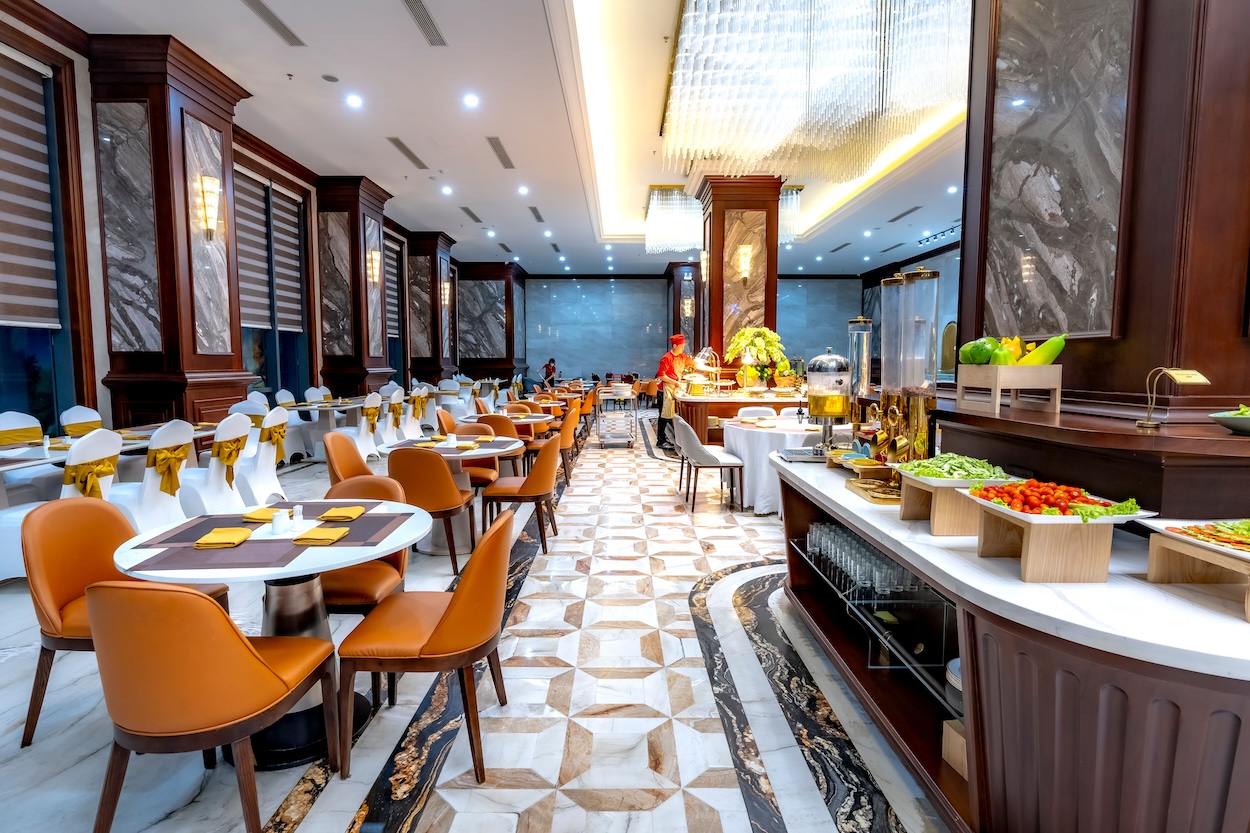
Acoustic comfort is no longer a luxury; it is a critical component of a restaurant’s commercial success. When excessive reverberation takes over a space, it has tangible consequences for the business:
- Negative Online Reviews: Excessive noise is consistently ranked as one of the top complaints by diners. Reviews citing that a restaurant was ‘too loud to think’ or ‘impossible to have a conversation’ actively deter new bookings.
- Reduced Dwell Time: Customers who are acoustically fatigued are less likely to stay for dessert, order an extra bottle of wine, or return for future visits. Research has found that increasing restaurant noise can negatively affect customers’ willingness to spend both time and money in a venue.
- Staff Fatigue and Errors: Waiting staff working in high-stress, echoing environments suffer from auditory fatigue, which can lead to miscommunication, order errors, and lower overall job satisfaction.
Practical Ways to Reduce Restaurant Noise and Reverberation
Fixing a noisy restaurant involves introducing targeted sound absorption to soften the hard surfaces and stop sound waves from rebounding endlessly. This is typically achieved by treating the two largest surface areas in the room:
Acoustic Ceiling Treatments
The ceiling is usually the most effective place to introduce acoustic treatment because it offers a large, unobstructed canvas that is out of reach of daily wear and tear.
- Suspended Ceiling Rafts and Baffles: Hanging acoustic absorbers directly above seating areas provide high-performance sound absorption, helping to reduce reflected sound and overall reverberation throughout the dining space. Acoustic baffles can be easily integrated around existing lighting rigs, HVAC ducting, and architectural features.
- Direct-Fix Panels: For spaces with lower ceilings, high-performance acoustic tiles can be fixed directly to the soffit, providing an effective and discreet way to introduce sound absorption without reducing headroom.
Acoustic Wall Treatments
Wall-mounted acoustic panels absorb sound that would otherwise reflect from large hard surfaces, helping to reduce reverberation and strong reflections within the dining space. Acoustic screens can also be used to subtly divide larger open-plan areas and provide some local separation between seating zones.
Integrating Acoustic Treatment into Existing Interior Design
A major concern for restaurant owners is that acoustic treatment will ruin the carefully curated aesthetic of their dining room. However, modern acoustic treatments are highly customisable and designed to complement existing décor.
Acoustic treatment can be designed to blend discreetly and seamlessly into the existing architecture, with solutions such as stretched fabric systems creating a finish similar to a standard painted wall. Alternatively, it can be used as a deliberate design feature. Timber slat acoustic panels can add warmth and texture to a space, while acoustic artwork panels can incorporate branding, photography or bespoke graphics into the treatment. Good acoustic design should complement the interior, ensuring the acoustic solution enhances the visual environment rather than detracting from it.
Calculating the Right Amount of Absorption
A common mistake in treating restaurant noise is taking a guesswork approach. Simply sticking a few panels on a wall will rarely solve a severe reverberation issue, while over-treating a room can kill the vibrant atmosphere entirely.
The exact amount of acoustic absorption required must be calculated properly based on the specific physics of the room. This involves measuring the total volume of the space, identifying the existing hard finishes (glass, concrete, wood), and measuring the existing reverberation time (RT60). Only with this data can you determine the required square metres of acoustic treatment needed to bring the reverberation down to a comfortable, conversational level.
Why Professional Acoustic Assessment Adds Value
Because every restaurant’s acoustic signature is entirely unique, off-the-shelf solutions often fail to deliver the desired results. A professional acoustic assessment removes the guesswork.
By working with acoustic specialists, restaurant owners benefit from accurate on-site measurements, expert design that respects the interior aesthetic, and specification of the correct materials for a commercial hospitality environment. Furthermore, professional installation ensures the treatments are fitted safely, securely, and installation can often be scheduled around trading hours to minimise disruption.
If excessive noise is impacting your diners’ experience, Koru Acoustics can help. We offer full assessments of your restaurant’s space to identify the primary causes of reverberation and provide expert, customised solutions that protect your atmosphere and your bottom line. Contact our team today to arrange a free site survey.